Carrying It On for Assata Shakur, Symbol Of Black Liberation
Carrying It On for Assata Shakur, The Embodiment Of Black Liberation
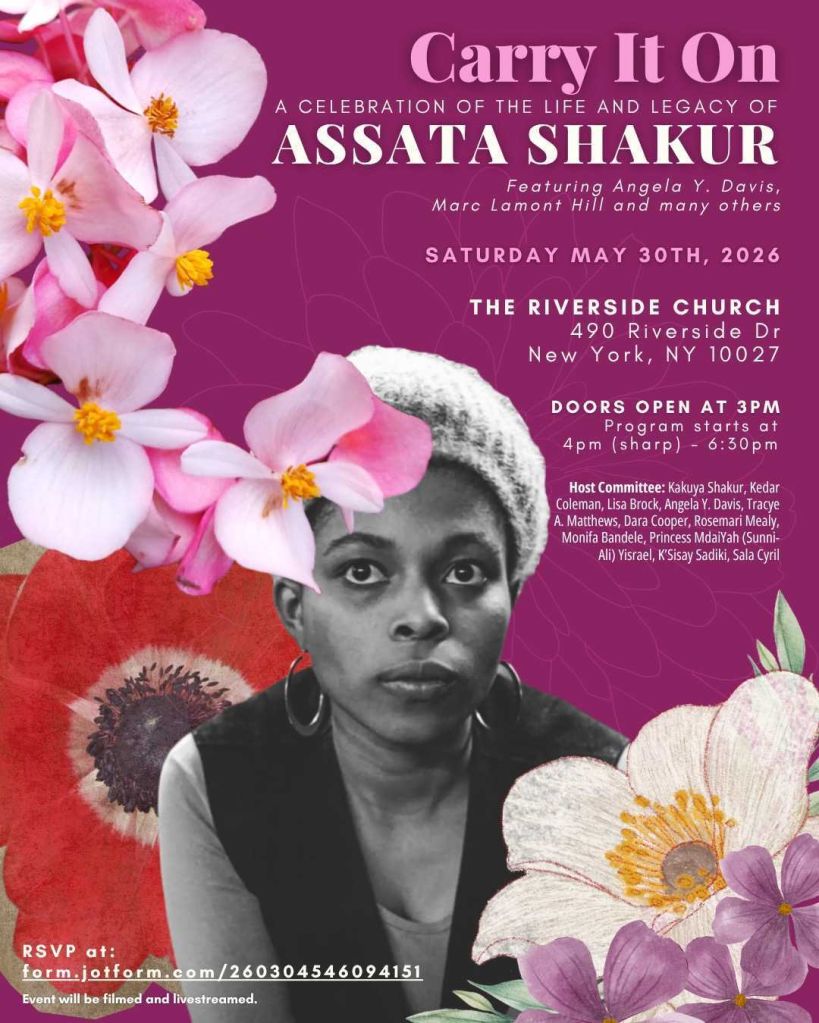
On Saturday, May 30, all those who believe in the bounty of Black liberation will gather at The Riverside Church in New York City to honor the life and legacy of the indomitable Assata Shakur.
Carry It On: A Celebration of the Life and Legacy of Assata Shakur is the name of the event, and its title is both instruction and inheritance. Angela Y. Davis and Marc Lamont Hill are among those featured to speak. The Host Committee itself is a gathering of some of the most committed Black liberationist organizers of the last several decades, including Kakuya Shakur, Kedar Coleman, Lisa Brock, Angela Y. Davis, Tracye A. Matthews, Dara Cooper, Rosemari Mealy, Monifa Bandele, Princess MdaiYah (Sunni-Ali) Yisrael, K’Sisay Sadiki, and Sala Cyril.
The event will be filmed and livestreamed because Assata has always understood that the people who most need the life-affirming words to be spoken during this celebration may not be able to get to the room.
This is one of many gatherings offered in her name since Assata Shakur became an ancestor on September 25, 2025. Black Women Radicals honored her alongside trans activist Miss Major Griffin-Gracy as testaments to the radical Black feminist imagination. The Anti Police-Terror Project built community altars in the Bay Area. Black Lantern Books gathered community in LA’s Leimert Park. Chicago’s Assata’s Daughters—the collective for young Black girls and femmes built in her spirit—continues to offer the political education she modeled. City to city, organization to organization, the movement has refused to let Assata pass quietly.
This is what it looks like when a freedom fighter dies free.
We are also gathering right now because we need to. Not only to honor Assata, but because the moment she spent her life fighting against has not passed. In fact, it appears to be sharpening. FBI Director Kash Patel re-branded her a terrorist posthumously, warning the public not to “romanticize” her, as if our love for Assata is the problem and not his agency’s decades-long war on Black lives and Black freedom.
We see this same hostility mirrored in a broader, systemic assault on our survival. The current administration has intensified ICE raids on Black and brown neighborhoods, arresting people without criminal records and in violation of constitutional protections. They have deployed the National Guard into cities like Los Angeles, Chicago, Memphis, and Washington, D.C., over the objections of local governments and federal courts. By revoking civil rights-era protections dating back to the Johnson administration, they have engineered what has been called the biggest civil rights rollback since Reconstruction.
That this machine could not allow a 78-year-old Black revolutionary woman to transition from this life without rushing to remind us she was “the danger” tells us everything we need to know about who the state fears and why.
We are celebrating Assata Shakur because reclaiming revolutionary memory is a Black political strategy. When the state works overtime to distort and erase our past, gathering to say her name out loud is an act of resistance. And right now, when Black people are in the hardest fight of a generation for basic human rights, political representation, and the freedom to exist without state violence, we need every ancestor and every story that showed us what refusal looks like.
Assata Shakur showed us. She refused. Completely. Her entire life.
When I found Assata Shakur and her story of radical care and resistance, I found the language for what I never even believed was possible. Assata: An Autobiography reached me the way the best books do—passed down, already annotated, smelling faintly of someone else’s devotion. To say the book changed my life seems too general a statement, too incomplete. Her autobiography became a North Star for me as I came to truly understand what Black love and Black solidarity mean in action.
What changed me most in reading about Assata’s journey was that she was a woman. Fully. She was both fierce and tender, both revolutionary and maternal, and she never asked permission to be any of it. I had grown up loving King, Malcolm, Newton, Hampton—studying them, carrying their words in my chest. But they were men. And I, a young Black girl becoming a young Black woman, was looking for evidence that there was room in this struggle for me.
Assata Olugbala Shakur gave me that evidence. She named herself into existence the way our ancestors named themselves into freedom—with each syllable offering a declaration.
Assata: she who struggles. Olugbala: love for the people. Shakur: the thankful.
Born JoAnne Deborah Byron (later JoAnne Chesimard) in Queens, N.Y., on July 16, 1947, Assata chose the name that told the truth about who she was becoming and what she was willing to carry.
By the late 1960s, she was organizing with the Black Panther Party—running free breakfast programs, building community health clinics, holding Harlem together with the kind of love that wasn’t broadcast on the local news. When the BPP became the FBI’s number one target under COINTELPRO, the counterintelligence program J. Edgar Hoover designed to destroy Black radical organizations, she kept organizing. She chose not to shrink or soften. She chose to be fully herself, and the state found that intolerable.
They always do.
She was accused, arrested, acquitted, and targeted again— six separate criminal cases, five of which collapsed because the evidence against her was too thin to stand even in courts not built with her justice in mind. Then came May 2, 1973. A stop on the New Jersey Turnpike, supposedly for a faulty taillight. Assata was shot twice—once with her arms raised, once from behind. Forensic evidence confirmed she had not fired a weapon. A broken clavicle made it physically impossible for her to raise her right arm to shoot. And yet, in 1977, an all-white jury convicted her of murder and sentenced her to life plus 33 years.
In her own words: “I am not a criminal, nor have I ever been one.”
She was placed in a men’s facility. Denied adequate medical care. Beaten. Called out of her name. None of it broke her. In 1979, she was liberated from Clinton Correctional Facility by comrades who refused to leave her there to die. No shots were fired. She walked toward freedom and did not stop until she reached Havana.
Cuba granted her political asylum in 1984. She went on to raise her daughter, Kakuya. She taught. She wrote. She called Cuba one of the “largest, most resistant and most courageous Palenques—maroon camps—that has ever existed on the face of this planet.” She lived fully and freely for 40 years in exile.
She was 78 years old when she transitioned. And she died free.
We have to pause and sit with that. In a country that spent decades trying to drag her back in chains—doubling the FBI bounty on her head to two million dollars in 2013 and making her the first woman added to the Most Wanted Terrorists list—she simply outlasted them. She outlasted the agents who hunted her, the politicians who weaponized her name, the news cycle that tried to reduce her to a mugshot. She chose life over the slow execution of a prison cell.
She showed us, over and over, that “no” was possible.
What I keep returning to is what Assata gave me personally—what she gave so many of us who grew up Black and female and politically alive in this country. She made room. She showed me that Black women had led liberation movements, bled for them, built the infrastructure of them, and been hunted for them. We had always been here. We had simply been edited out of the story.
She put her grief on the page alongside her analysis. She wrote about her daughter with the same precision she brought to her critique of COINTELPRO. She showed us, chapter by chapter, that you can be both human and revolutionary. That vulnerability is clarity. That love for the people and love for yourself can live in the same body.
“I am only one woman,” she wrote from Havana. “I own no TV stations, radio stations, or newspapers. But I feel that people need to be educated as to what is going on.” And then she kept writing. From exile, with a bounty on her head, with the FBI still watching. She kept writing because the people needed to know, and she was willing to be the one to tell them.
That is a model. That is what it looks like to do the work anyway—to write anyway, to love Black people anyway—when the state has named you an enemy, and the world has been told to fear you.
The organizers who built Carry It On understand this. Kakuya Shakur planning a celebration for her mother. Angela Davis lending her voice. Monifa Bandele, Dara Cooper, Tracye Matthews—women who have given decades to this work—coming together to say her name in a room full of people who know what it cost her to say her own. This is a continuation—the movement doing what movements do when they are healthy: they honor, they transmit, they carry it on.
We are in a hard moment. The attacks on Black life are not new, but they are newly emboldened—the erasure of our history from classrooms, the weaponization of federal agencies against our communities, the political disenfranchisement dressed up as election integrity, the daily grinding message that our lives, our families, our existence are negotiable. In the middle of it all, we gather. We say her name. We remember what she knew: that freedom is not a destination you wait for. It is a practice you inhabit, daily, in your body, in your choices, in your refusal to be made small.
She lived that. She died in it. She left it for us.
We owe her nothing less than carrying it on.
It is our duty to fight for our freedom.
It is our duty to win.
We must love each other and support each other.
We have nothing to lose but our chains.
SEE ALSO:
Revolutionary Fighter For Black Liberation Assata Shakur Dies At 78
Celebrating And Remembering Black Panther Assata Shakur
Op-Ed: Assata Shakur And The Endless War Against Black Liberation
Assata Shakur Lived And Died Free
Angela Davis: FBI Targeting Assata Shakur ‘Reflects Very Logic Of Terrorism’ [VIDEO]
Carrying It On for Assata Shakur, The Embodiment Of Black Liberation was originally published on newsone.com





