WNBA: Free Raven Johnson, Or At Least Protect Her
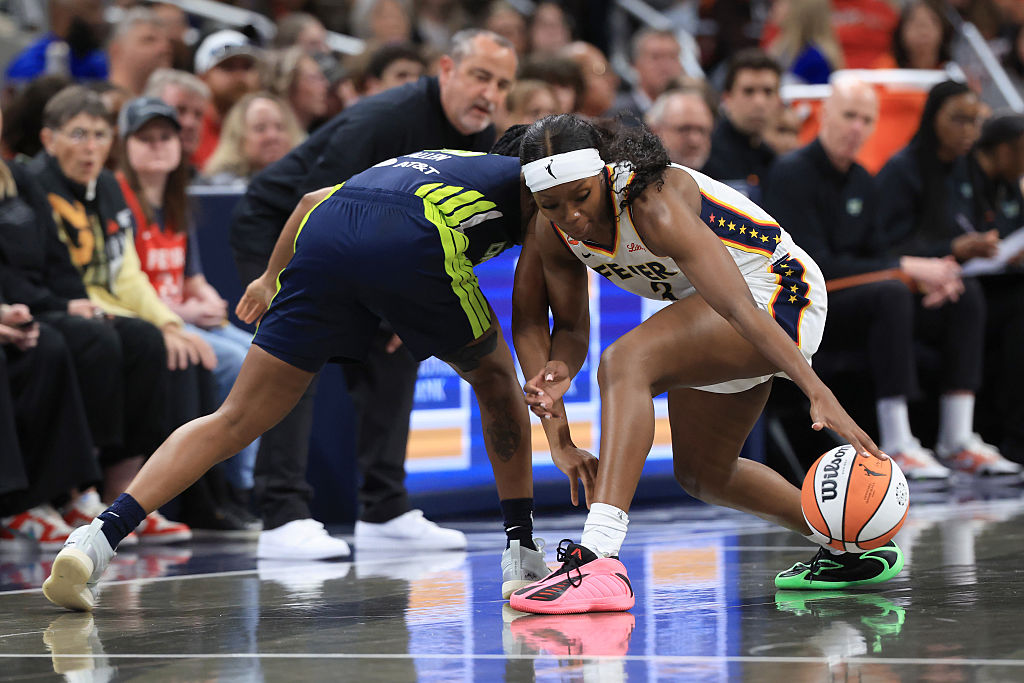
I watched the Raising GOATs video the WNBA released earlier this month that honored the future of the league and the younger generation of players poised to become the next generation of GOATs. The video was an important reminder of the strong talent the league has in its hands.
It’s hard not to imagine how an updated version of that video would look even one month from now that incorporates the new crop of WNBA rookies as they make the transition into their new WNBA careers.
It’s easy to imagine the updated video including a quick release 3-point shot from Dallas Wings rookie and No. 1 draft pick Azzi Fudd, a crafty behind-the-back dribble followed by a no-look pass executed with precision by Minnesota Lynx rookie Olivia Miles, and a 360-degree spin move followed by a pull up jumper from new Seattle Storm rookie Flau’Jae Johnson. They are the league’s future GOATs and they are exciting to watch.
This group of women also become history-makers this season, as the first rookie class to walk into the WNBA with contracts that now guarantee them the highest pay the league has ever paid its players. Rookie salaries this season are as high as $500,000 a year, compared to the $76,000-$78,000 WNBA rookies made last year.
But, the players also walk in aware of the history that precedes them.
This is especially true for Black women basketball players who, especially in recent years, have encountered racism both on the court and off of it.
As I wrote about earlier this month, one of my fears heading into the 2026 WNBA draft was that the Indiana Fever would recruit a young Black woman as its 10th overall pick.
The Fever did just that when they chose Raven Johnson from the University of South Carolina. I was pained by what seemed to be a forced smile on Johnson’s face as she stood next to WNBA commissioner Cathy Engelbert as she posed for her requisite picture holding an Indiana Fever jersey. Her response spoke volumes.
That jarring image was followed by a camera shot of her family reluctant to put on their Indiana Fever hats, a tradition for family members attending the draft in person. This sequence of events encapsulated the moment many of us Black women feared and were praying wasn’t going to happen. That a young Black woman collegiate player’s first experience in the WNBA would be on a team where some of its players and fans have a history of creating an unwelcoming if not downright hostile environment for Black women to thrive in. The reality of it is unconscionable and unnecessary.
To add insult to injury, Raven Johnson is being forced to be on a team with Caitlin Clark, a player who disrespected her on the court several years ago while both were still in college.
In a matchup between their (now) respective alma maters, Clark dismissively shooed off the opportunity to guard Johnson as she approached the 3-point line. The move dissuaded Johnson from shooting the 3, and instead, she passed the ball to a teammate. The play went viral on social media and resulted in a barrage of insults thrown mostly in Johnson’s direction.
Basketball highlights are usually chock-full of memorable moments. This one stands out because it is rooted in the disrespect of a young Black woman still finding her footing on the collegiate level as a freshman. Maybe it would have been highlight worthy in the traditional sense had Johnson taken and made a 3-point shot during that play. That’s not what happened, and I’m glad she didn’t attempt the shot. If she’d made it, it might not have made the highlight reels. If she’d shot the ball and missed, the aftermath and barrage of attacks she experienced would likely have been far worse.
Following that incident, Johnson spoke openly about entering into a so-called revenge tour seeking vindication after the affront that culminated in a magnificent win against Clark’s team in the 2024 national championships. During that game, Johnson’s defensive skills while guarding Clark were lauded, helping her team close an early lead against the Iowa Hawkeyes. Johnson and the Gamecocks would go on to win the game by a dozen points. After the game, Johnson declared the revenge tour was over.
By the time Johnson graduated from the University of South Carolina in 2026, she would have two national championships under her belt, while Clark walked away without a single college national championship.
Even with those wins, and after declaring the revenge tour over more than two years ago, headlines of top national news outlets have attempted to revive the rivalry.
The same week the Fever drafted Johnson, a headline for the L.A. Times read, “Raven Johnson’s ‘revenge tour’ adds a surprise stop: Getting drafted by Caitlin Clark’s WNBA team.“ The first line in their piece continued to stoke the flames Johnson extinguished years ago: “It turns out Raven Johnson’s ‘revenge tour’ wasn’t completely over.” The line suggests that Johnson, in some way, chose the Fever, and it centralizes Johnson as the agitator.
It’s a familiar storyline even outside of competitive sports. It reminds me of one of the more heartbreaking storylines in the 1984 movie, The Color Purple, based on the novel by acclaimed author Alice Walker. One of the characters, Sophia, played by Oprah Winfrey, refuses a job offer to become a maid for Miss Millie, the wife of the town’s mayor. Her response is a robust, “Hell no,” which is met with a slap from the mayor across her face for disrespecting his wife. Sophia punches the mayor while a group of white people from the town yell at her, call her the “N” word, and ask her, “Who the hell do you think you are?” The scene draws to a close when the town sheriff approaches and pistol-whips Sophia. She is imprisoned for several years, and one of the terms of her release is that she is ordered to become Miss Millie’s maid.
Miss Millie makes it clear through her treatment of Sophia upon Sophia’s release that Sophia should feel grateful for being sent to work for her. In one scene, Sophia is expected to be grateful that Miss Millie promises to drive her home to spend time with her family for Christmas, for what ended up being a shorter-than-expected stay. While Miss Millie had promised she could stay all day, her visit was ultimately cut short when Miss Millie had problems driving on her own and was scared by Sophia’s family members, who were trying to help her. Ultimately, Miss Millie forces Sophia to accompany her back home.
In the same way, Indiana Fever fans have already begun the work of demanding Johnson’s gratitude for having been brought into their favorite player’s team. Clark fans have also been furious that she was drafted after speaking ill of them.
In both cases, the dismisser (Clark/Miss Millie) stands to profit from the dismissed Black woman’s (Sophia/Johnson’s) labor while expecting her to smile through it. In Johnson’s case, there is an audience full of fans, analysts, and critics ready to attack her on and offline if she signals anything less than enthusiasm about serving Clark’s ascendance.
For Johnson and Sophia, their labor has been rerouted in the service and maintenance of a white woman’s ascendance, deployed to hide the white woman’s shortcomings. It is no secret that Johnson will be tasked with guarding the players Clark cannot guard and creating the conditions for the team to flourish. Johnson brings with her qualities that Clark lacks. She’s got strong defensive instincts, court vision, and championship-caliber habits instilled in her from Dawn Staley’s Gamecocks program.
These talents will be metabolized into Fever wins, which will be filed under Clark’s leadership and the league’s ongoing Clark-centric marketing project. In other words, Johnson becomes the substrate. Clark’s brand gets a boost, and she becomes the headline. This is an old arrangement in American life that cuts across racial lines, and now the WNBA is staging a high-resolution version of it for us all to watch unfold. It’s one that is unfair to Johnson, who should not be put in a position to carry the burden of this history. Asking or expecting her to fix it by striking a perfect balance between dignity and team-first cooperation is not the solution.
This is not the usual story we see unfolding ahead of every new season of a team drafting a defensive specialist to round out its backcourt. Roster construction rarely carries any weight beyond basketball. What separates the Johnson pick is the cultural apparatus she is being drafted into that envelops her into a years-long marketing project organized around Clark that has already turned Black women who guard her too closely into villains, every critique of Clark’s game has turned into an unhinged referendum on race, and every roster move has put her at the top of a hierarchy she’s not yet earned on the court.
Johnson’s basketball selection is sound. She will raise the bar and could singlehandedly propel the Fever into championship waters. The arrangement Johnson is walking into is something else entirely. To deny this reality is to deny and ignore two seasons of evidence about how this fanbase, this league, and this social media and larger media ecosystem treat the Black women who share the floor with Caitlin Clark. It also denies the impact it has had on the Black women at the center of it.
Johnson has spoken openly and recently about the impact the college incident had on her.
During a recent guest appearance on the I Am Next podcast, Johnson shared the online hate she received after the incident, “I was all over the internet. That’s one reason I hate the internet now, because of that situation. I got bashed. I got bullied. I got called all these things that I wasn’t — like a monkey. … It was just things like that, and I just thought I wanted to quit basketball at that time. I wanted to go in this little bubble of isolation and just be by myself.”
A player shouldn’t have to worry about being drafted or traded into any team because of its refusal to actively enforce a zero tolerance policy about racism both on and off the court.
It is part of the job of the team and the league and their PR/marketing teams to head off any possible controversy. Perhaps it’s unsurprising given that in the past the league, and more specifically the WNBA commissioner Cathy Engelbert, has seen rivalries as good for business even as they have been most harmful to Black women players.
Protect Black women.
That one short line has become a refrain I’ve repeated often and one that bears repeating right now. The Fever has an opportunity to begin to shift the narrative. Their first stop should be to commit to not marketing Johnson as a supporting character in the Clark story. They can instead build a robust communications plan that highlights her skills as a player, her championship pedigree, and taps into her loyal following from South Carolina’s enormous fanbase.
The Fever and Clark are already falling short of welcoming their first round draft pick. Clark faced criticism that she was displaying poor leadership by not taking to social media to post a customary welcome message for Johnson. In a TikTok video, Clark was called out about the nonexistent welcome and many of the commenters agreed. One user said that when she played in Iowa, Kate Martin was the captain, not Clark. Another user commented: “Caitlin is not the leader of her team. She’s also not the best on the team.”
For now, Johnson is settling in nicely with her new team. In her WNBA debut on April 25, Johnson was perfect from the field, scoring on all three of her shot attempts to finish the game with 6 points. She also had 8 assists, 3 rebounds, 2 blocked shots, and 1 steal. She had no turnovers during her 18 minutes on the court. Clark had 7 points in 17 minutes and was merely 2 for 10 from the field.
The Fever and the league would be wise to leave room for switching their marketing strategy and aligning to what the basketball players’ successes on the court ultimately reveal. This is, after all, a team that made it deep into the playoffs without Clark and on the backs of Black players like Kelsey Mitchell and Aaliyah Boston.
Johnson is showing early that she has the basketball acumen and talent to become a star for the Fever and for the league. If Johnson, Mitchell or Boston become the better players, and the early returns suggest they could, the Fever organization, Clark herself, and the league need to make room for that possibility rather than spending the next decade insisting on forcing a hierarchy that is gravely out of touch with performance on the basketball court.
SEE ALSO:
An Open Letter To WNBA Commissioner Cathy Engelbert
On Dawn Staley, Black Women, And Disrespect In The Workplace
WNBA: Free Raven Johnson, Or At Least Protect Her was originally published on newsone.com