A Houston Mother Humiliates Her Son For Hurting A Cat
A Houston Mother Humiliated Her Son For Hurting A Cat - Page 3
This looks less like discipline and more like an insecure parent turning punishment into theater, possibly reenacting the kind of more private humiliation once done to her .
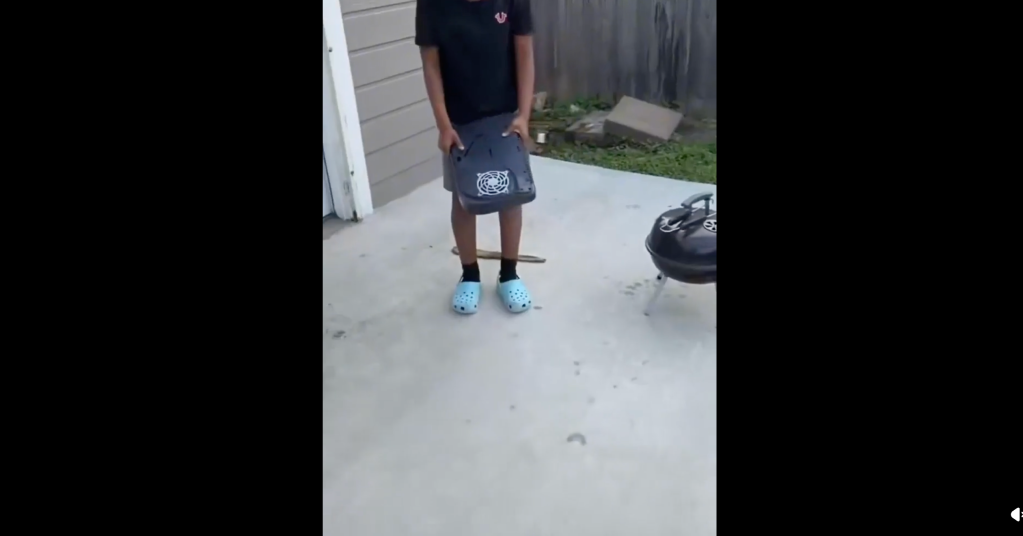
In a backyard in Houston, a boy stands there while his mother, Sivell “SunShine” Burton, orders him to slam his PlayStation 5 into the ground as punishment for allegedly hurting her four-month-old tabby kitten, Garfield.
Her voice is sharp, angry, relentless, and cussing at the child. It is not corrective, nor is it the voice of a parent trying to teach regulation, empathy, or the value of a life to a child accused of hurting an animal. She commands him to pick up the gaming console and slam it the way she says he picked up her cat and repeatedly slammed him. Then she starts directing the scene like her punishment has a script.
“Do it!”
He obeys.
Then she moves something out of the way so he can slam it harder, telling him, “Let me move this for you, baby.” She says this with a tenderness so twisted it makes the whole scene feel even more disturbing, “so you know it’s real,” she says.
That line is chilling because it reveals the point of the punishment. This is not about the cat anymore. This is about making the child feel powerless and making him perform humiliation on command. It is ritualistic. It has the cadence of an adult who needs a witness, and who needs the child’s humiliation to be seen, validated, and applauded so that she and the audience can bond over his suffering and their own.
That is the unspoken contract in so much viral punishment content. The adult offers up the child’s pain, and the audience brings its own. People clap because the scene feels familiar. They recognize the terror, obedience, forced remorse, brokenness, and the adult rage dressed up as love. But instead of grieving what was done to them, they defend it. Instead of calling it abuse, they call it discipline, and they applaud. Instead of protecting the child in front of them, they protect the wounded adult inside themselves.
“Pick it up and do it again!”
Again and again, she orders him to lift the console and smash it. She tells him to stand on his tiptoes and slam it as hard as he can.
The boy is crying through it. Not learning. Not reflecting. Crying. And while he cries, she keeps going. The cussing keeps coming. The orders keep coming. Pick it up. Do it again. Pick it up. Do it again.
Over and over and over.
And that is where the scene gets even uglier. Because this looks less like discipline and more like an insecure parent turning punishment into theater, possibly reenacting the kind of more private humiliation once done to her and now calling it parenting because the child gave her a reason to unleash it. The boy is not being taught empathy. He is being made into an offering for public consumption by millions of strangers.
His tears, obedience, and broken console become proof. Proof that she is in control. Proof that she is a “good mother.” Proof that the internet should clap for her. But children are not supposed to be the altar where dysregulated and wounded adults go to prove they still have power.
This is not a teaching moment. It is a forced reenactment. It is a child being made to perform destruction while an adult narrates his shame. His mother tells him he has anger issues while her own anger is on display. She says, “We gonna fix them today,” but nothing about what we are watching is fixing the anger. This is an adult taking a child’s alleged cruelty and answering it with her own.
And then, after the console is broken, after the crying, commands, all the cussing and humiliation, she tells him to pick it all up and throw it in the trash.
That is the scene people across social media are applauding. Not a child being guided toward empathy. Not an injured animal being centered. Not a parent helping a child understand the difference between a living body and an object. A child crying while an adult screams, cusses, records, and forces him to destroy something he loves.
And somehow, because the child is accused of harming a cat, people have decided this is what accountability looks like. It is not. Accountability does not require a child to be publicly broken. Discipline does not need an audience. And if the lesson is supposed to be that violence is wrong, then maybe the adult should not deliver it through fear, force, humiliation, and destruction.
According to Atlanta Black Star, Burton later posted an update saying Garfield was alive and recovering, though still injured.
So let’s be clear before the comment section starts foaming at the mouth: hurting an animal is serious. If this child harmed that kitten, then Garfield needed immediate protection and medical care. The child needed intervention, supervision, accountability, and real adult guidance. Nobody serious is arguing otherwise. But that is not what this video shows.
This video shows a mother responding to alleged violence with more violence and trying to teach empathy through humiliation. It shows destruction being used to “correct” destruction. It shows a child’s worst moment being turned into content and handed over to millions of strangers who will never know him, love him, guide him, protect him, or be responsible for what happens to him after the video stops trending. And somehow, people are calling this “good parenting.”
Public humiliation is not a parenting strategy or love with a hard edge. There is no acceptable version of filming a child’s fear, shame, confusion, or distress and handing it to the internet like an offering. Once a parent turns punishment into content, the lesson is already dead. The child is no longer being guided toward repair. He is being staged for public consumption. The audience becomes part of the punishment, and the comment section becomes part of the beating.
What the internet is refusing to examine is the obvious question: where did this child learn to handle anger with force?
Children who hurt animals need serious attention, but cruelty toward animals does not emerge from nowhere like some demon kicked open the nursery door. Sometimes it is a sign that a child has been exposed to aggression, intimidation, verbal abuse, hitting, chaos, or adults who teach through fear instead of connection. Sometimes it is a child taking the language of power he has absorbed and using it on someone or an animal weaker and unable to fight back.
And in this case, we do not have to invent some wild theory about the home environment. The mother gave us evidence of her own emotional toolkit. We can hear it. We can see it. She screams. She curses. She dominates. She humiliates. She tells him he has anger issues while demonstrating her own. She forces him to reenact harm through destruction while insisting she is teaching him something.
So when people say, “He needs therapy,” I want to ask: why does the child become the only patient in this story?
Yes, he may need professional assessment and help to understand empathy, impulse control, anger, and harm. But therapy cannot compete with a home where the adult is modeling the very behavior the child is being punished for. You cannot send a child to therapy for emotional regulation and then bring him home to an adult who regulates herself by screaming, cussing, filming, and publicly degrading him.
And then come the amateur profilers in the comment section, calling this boy a future serial killer, a monster, a psychopath, a danger to society. People who do not know his name, his age, his history, his school, his home, his trauma, his development, or the full story are diagnosing him from a viral clip like they have a psychology degree. Stop it.
A child harming an animal is a warning sign, not a prophecy. It means intervene. It means protect the animal. It means investigate what the child has been exposed to. It means bring in help. It does not mean the internet gets to write him off as broken, evil, or destined for violence before he even has a chance to be properly assessed, guided, or repaired.
And if we are going to talk about who needs help, then we need to be honest: the mother needs help too. A regulated adult does not turn a child’s punishment into a public ritual. A healed adult does not need millions of strangers to validate how hard she can humiliate her own child. A secure parent does not use a camera as a weapon and then call the applause accountability.
What she did made everything worse. She did not just punish him. She branded him. This boy will have to live with this video long after the internet gets bored and moves on to the next spectacle. He may go to school and face classmates who have seen him crying in that backyard. He may be mocked, teased, feared, or treated like the “cat boy” whose mother made him smash his PS5. He may grow up and find strangers still calling him twisted, dangerous, evil, or a future killer. He may one day search his own name, his mother’s name, or this story and watch his childhood shame still breathing on the internet.
That kind of exposure does not build accountability. It builds resentment, humiliation, and distrust between a parent and child. It teaches a child that the person who was supposed to protect him was willing to trade his dignity for public approval.
This child deserved an adult who could handle the situation without turning his pain into a viral punishment ritual. He deserved correction without degradation. He deserved accountability without public shaming. And he deserved intervention without being offered up to the comment section for cruel digi-punishment.
Instead, his mother turned correction into spectacle. She took a serious moment that required privacy, maturity, and real intervention, and handed it to the internet for validation. And the internet showed exactly what it values.
Too many people did not watch that video with concern. They watched it with recognition. They saw a crying child being screamed at, humiliated, and forced to destroy something he loved, and something in them said, good. Not because it was healing or instructive, but because it felt familiar. They enjoyed the crying and the fear. They enjoyed seeing a child forced to destroy something he loved. They called it discipline because admitting they were entertained by a child’s humiliation would require too much honesty.
Because too many unhealed adults still confuse suffering with discipline. They see a child being publicly broken and call it accountability because somebody once broke them and called it love. They cheer for humiliation because they survived humiliation. They defend cruelty because admitting it was cruelty would force them to grieve what was done to them.
That is the sickness here.
The cat’s suffering became the excuse. The child’s suffering became the show. The audience became part of the abuse the moment they started clapping. And the algorithm rewarded it all as his childhood became inventory in the attention economy.
So now we have a wounded animal, a dysregulated parent, a humiliated child, an entertained audience, and a platform that profited from all of it. And somehow people still want to call that a lesson.