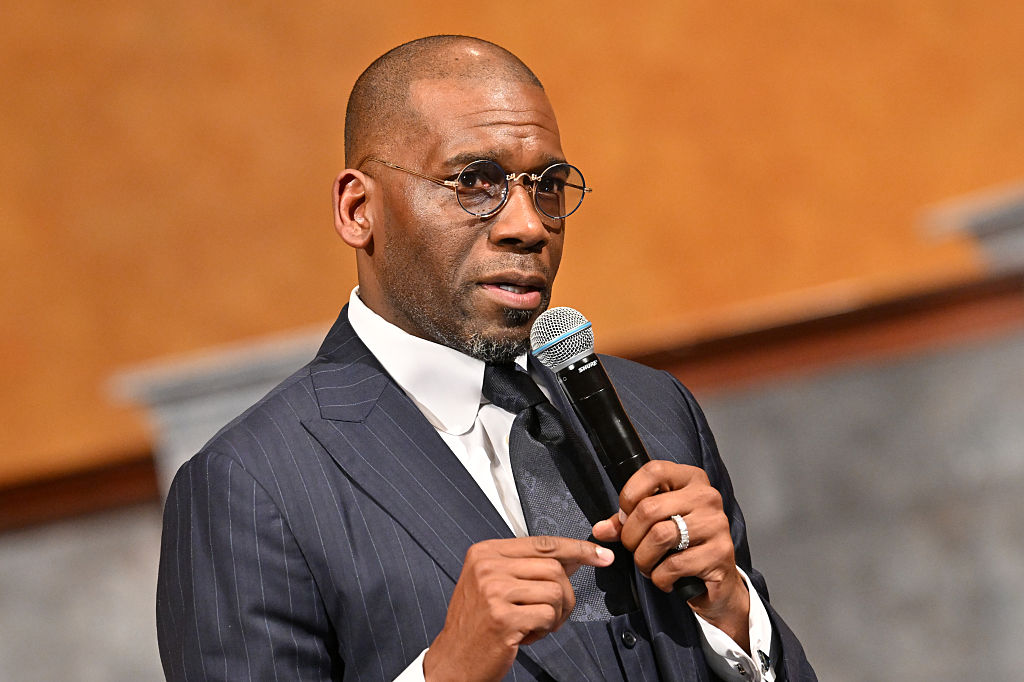
“I failed,” said the New Birth Missionary Baptist church leader, who took accountability for being out of touch and denied being paid by the corporation.
According to theGrio, Bryant addressed the controversy during the 100th episode of hisLet’s Be Clear podcast, where he apologized for the confusion caused by his earlier remarks and acknowledged he misread how the community viewed the protest.
“This week, I failed…I called for the end of the Target Fast,” Bryant said on the podcast, explaining that many supporters were “disappointed, angry, frustrated, and bewildered” by the announcement.
Bryant Apologizes For Being “Out Of Touch”
During the podcast, Bryant admitted that his interpretation of the movement’s progress did not align with the community’s expectations, prompting him to publicly apologize.
“I wanted you to know that I’ve heard your emphatic outcry,” Bryant said. “I made assumptions that were not true. And I wanted to apologize to you for being a leader that was out of touch with what it is that the community wanted.”
The Atlanta pastor, who leads New Birth Missionary Baptist Church, had launched the Target Fast as part of a broader protest against the retailer after criticism surrounding its diversity, equity, and inclusion commitments.
However, Bryant emphasized that his personal fast ending should not be interpreted as the end of the national boycott noting that the Target Fast was just a strategy and a tactic of the Target boycott,” stressing that it “was not to take its place,” or being “a leader that was out of touch with what it is that the community wanted.”
He also added that he did not want “history to record that I tried to stand in the way of the leadership of warrior women.”
He also stressed that neither he nor his church received compensation from the retailer, saying they can stand with “clean hands and a pure heart, unbought and unbossed” in the words of the late Hosea Williams.
Activists Say The Target Boycott Is Still Ongoing
As previously reported, the boycott organizers quickly responded to Bryant’s announcement, stressing that the broader protest remains active.
“Let’s be clear: the Target boycott is not over,” boycott founder Dr. Nekima Levy Armstrong said in a statement released through CAIR Minnesota. “This is a grassroots movement led by communities demanding corporate accountability.”
Activist Tamika Mallory also echoed that sentiment in an interview with Roland Martin, arguing that the economic pressure created by the boycott demonstrated the power of collective spending.
“What are we going to do next? What is the evolution even beyond Target? Which companies are next?” Mallory said. “That’s our collective power.”
Minnesota Organizers Reaffirm Boycott Where It Began
The Minnesota Star Tribune reports that organizers in Minneapolis say the boycott remains strong in the city where the movement first gained traction. Activist Nekima Levy Armstrong, who initially called for the Target boycott on Feb. 1, 2025, joined organizers Monique Cullars Doty and Jaylani Hussein for a news conference outside Target’s headquarters on Nicollet Mall.
The activists said Target has not met the boycott’s demands and pushed back against any narrative that the protest had concluded. In the Minnesota Tribune, Levy Armstrong criticized Bryant’s earlier comments, saying he appeared to be taking credit for “a movement built on the blood, sweat, and tears of the people of the state of Minnesota.”
Bryant Denies Claims Of Financial Incentives
Bryant also addressed speculation circulating on social media that he ended the fast after reaching a financial agreement with Target.
According to Black Enterprise, the pastor firmly rejected those claims, saying neither he nor his church received compensation from the retailer.
“Absolutely not a dime for even our meetings,” Bryant toldCapital B Atlanta. “I bought my own plane ticket, bought my own hotel. Target has never even bought me lunch.”
Bryant also reiterated on his podcast that the protest movement was not centered around his leadership alone.
“I am surrounded by brilliant, beautiful Black women,” Bryant said, crediting activists such as Nina Turner, Nekima Levy Armstrong, and Tamika Mallory with leading the boycott. “Let the record reflect and show that it was Black women that started this movement.”
The Target Fast Was One Strategy In A Larger Movement
Bryant explained to Capital B that Target Fast was designed to mobilize the Black church to support the boycott, not to replace it.
The fast originally began as a 40-day campaign from Ash Wednesday to Easter in 2025, encouraging supporters to redirect spending toward Black-owned businesses and participate in collective economic action.
Bryant said approximately 300,000 people signed up for the initiative, helping create momentum around the movement’s economic demands.
Those demands included restoring corporate DEI commitments, honoring a $2 billion pledge to Black businesses, increasing investments in Black banks, and creating business education partnerships with historically Black colleges and universities.
While Bryant acknowledged the fast has officially ended, he emphasized that the broader push for economic accountability remains far from finished.
“The struggle continues,” Bryant said. “And the best is yet to come.”
Organizers say the boycott effort will continue as activists monitor whether Target follows through on the remaining demands tied to the movement.