Body Cameras Won't Change Anything For Kristi Noem Or ICE
Body Cameras Won’t Change Anything For Kristi Noem Or ICE
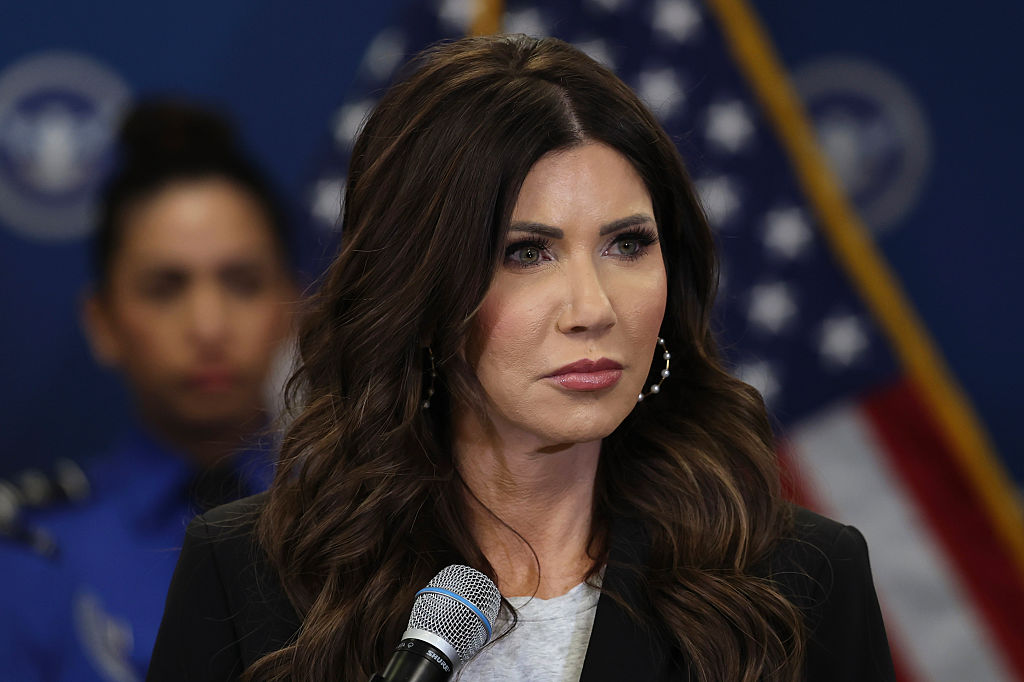
Kristi Noem should’ve just become an Instagram influencer and hawked beauty products. She could’ve just done GRWMs and talked about what foundation makes her look less like a ghoul. The former governor of South Dakota could’ve done what most politicians do when they leave politics and joined a firm in the private sector and disappeared from the public zeitgeist.
Instead, America has had to deal with her as the Secretary of Homeland Security, where she’s not only grossly incompetent, but she’s so far out of her depth that at this point it’s safe to assume that her resume said, “No Experience. Just Vibes.”


She’s so bad at her job that Congress members from both sides of the aisle have taken to calling on her to step down. That’s right, even some Republicans have taken a break from kissing the president’s adult diaper to note how woefully bad Noem is at her job.
And you know who knows this more than anyone? Kristi Noem.
Recently, Noem has taken a break from shooting her overproduced and needlessly expensive commercials (No, seriously. Noem spent some $200 million on commercials where she poses with a gun and tries to look tough. Oh and a firm she’s tied to also got a piece of that money) to call for a sudden embrace of body cameras for DHS and ICE officers. And it’s all being sold as accountability. In reality, it reads like triage.
Noem spent weeks blaming Renee Nicole Good for her own death, in which the Minneapolis mother of three was shot and killed on Jan. 7 while driving away from ICE officers. Noem even went as far as to call Good’s actions “domestic terrorism.” Taking a page out of the same playbook, Noem recently went on another round of assaulting the victim, after she blamed the Jan. 24 killing of Alex Pretti, a 37-year-old nurse for the United States Department of Veterans Affairs, who was assaulted, shot, and killed as he was trying to comfort a woman that ICE officers had just pushed to the ground.
Much like a co-worker who comes to the office late, eats smelly sandwiches at their desk, and uses the broom closet to take naps, Noem can feel the heat of unemployment on the back of her neck and wants to save her job.
Noem announced that federal officers—long resistant to the very transparency demanded of local police—would begin wearing body-worn cameras. And what was initially framed as a justified use of force, in Pretti’s death, has now been classified as a homicide.
Pretti’s death didn’t become explosive simply because another civilian was killed by law enforcement. It became explosive because of how aggressively the Department of Homeland Security tried to control the narrative afterward. Early statements painted Pretti as a looming threat. Officials emphasized weapons, danger, and split-second decision-making—familiar tropes meant to shut down questions before they fully formed. Then videos emerged. Witness accounts followed. And suddenly, the official version of events looked less like clarity and more like cover.
Noem didn’t lose control of the situation; she lost the plot. After footage of the shooting began to undermine her statements, activists and community leaders demanded answers. And this isn’t Noem going full Marjorie Taylor Greene on her switch-up as if she’s had some moral shift; this is all about self-preservation.
Which brings us to the body cameras.
For years, immigration enforcement agencies have argued that body cameras were impractical, too expensive, or unnecessary. The same excuses once offered by local police departments—until public pressure made resistance untenable. The demand that federal agents operate under the same standards as city cops didn’t appear overnight. It has been raised repeatedly by civil rights groups, members of Congress, and communities disproportionately impacted by immigration enforcement. Noem ignored it—until she couldn’t.
By the time she announced the policy, bipartisan calls for her impeachment were already circulating. Lawmakers weren’t just upset about Pretti’s death; they were alarmed by DHS’s handling of it. Misleading statements, refusal to immediately release information, and an apparent lack of internal accountability created the impression of a department operating above scrutiny. That’s a dangerous perception for any Cabinet secretary, especially one overseeing armed agents with sweeping authority.
So Noem’s rollout of body cameras isn’t reform, it’s damage control.
The same is true of her rhetorical shift around Pretti’s death. Calling it a homicide—after weeks of claiming that Pretti was the aggressor—didn’t demonstrate honesty. It underscored how much pressure it took to extract a more accurate description. Accountability that arrives only after political survival is threatened isn’t accountability at all. It’s a concession.
What makes this moment especially cynical is that body cameras alone do not guarantee justice. They document violence; they don’t prevent it. They record misconduct; they don’t punish it. Without clear rules governing when cameras must be activated, who controls the footage, and how quickly it is released, body cameras can become another tool of institutional protection rather than a means of public transparency. Critics know this. Noem knows this. And yet the announcement was framed as a moral awakening rather than a strategic necessity.
The irony is that Noem could have chosen a different path early on. She could have acknowledged uncertainty. She could have committed to an independent investigation without hedging. She could have embraced body cameras before a man was dead and her job was in jeopardy. Instead, she followed the oldest playbook in American law enforcement: defend first, disclose later, reform only when forced.
That pattern is why her leadership is now under threat. The impeachment calls aren’t just about one shooting; they’re about a worldview. A belief that federal power doesn’t require local accountability. That immigration enforcement exists in a separate moral universe. That transparency is optional until it becomes unavoidable.
And that is the real scandal of Kristi Noem’s tenure. Not simply that two people are dead after encounters with federal agents, but that her instinct wasn’t to find the truth — it was to manufacture a version of it. The body cameras aren’t a symbol of reform; they’re a receipt. Proof that accountability only arrived once the narrative she tried to build collapsed under the weight of video, witnesses, and political pressure.
Kristi Noem didn’t suddenly discover accountability. She ran out of ways to avoid it.
And that’s the problem with leadership built on vibes. Eventually, reality shows up with footage, timelines, and witnesses — and it doesn’t care how tough your campaign commercials looked.
SEE ALSO:
Kristi Noem Throws Stephen Miller Under The Bus As ICE Melts
Producer, DHS Mulling Reality Show Where Immigrants Compete For Citizenship
Body Cameras Won’t Change Anything For Kristi Noem Or ICE was originally published on newsone.com





